Demonstration build
Hollis & Vance LLP
Hollis & Vance LLP is a made-up business we built to demonstrate the work. The site is live and you can try it. The numbers shown on it are illustrative sample data.
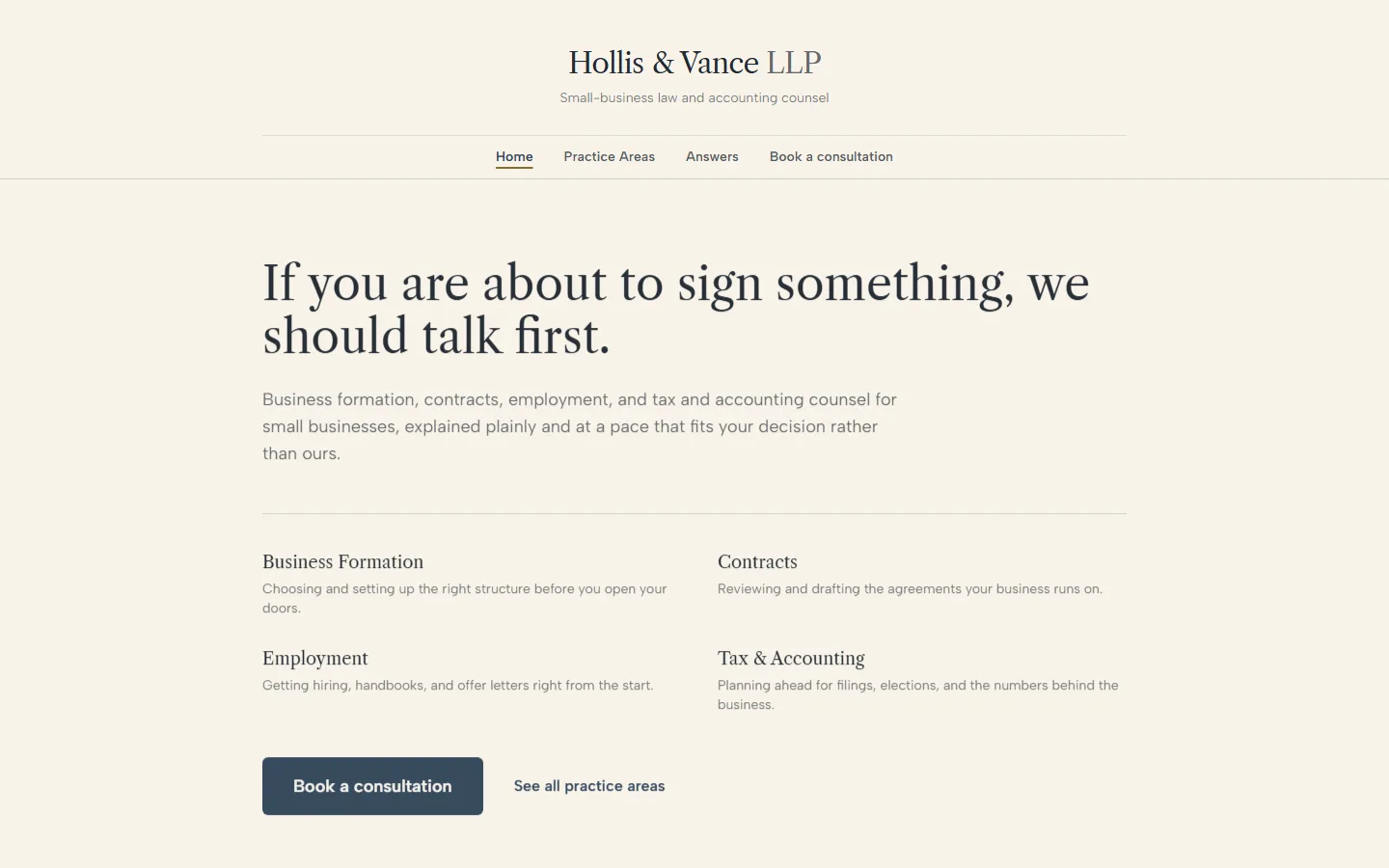
The problem
Hollis & Vance handles business formation, contracts, employment, and tax-accounting work across three attorneys, but the old site was a single "call our office" page. A prospective client with a routine question after hours had no way to get even a general answer, and booking a consultation meant a phone call during business hours to find out who covered their kind of matter.
What we built
A quiet, parchment-toned site built around a practice-area-first consultation flow, pick the practice area, pick a specific attorney or 'any available,' pick an hourly slot, plus a self-serve FAQ search over a 12-entry, capability-framed answer corpus (never a legal conclusion, always pointing back to a consultation for anything case-specific). Alongside it, published in full at /evaluation, is a worked Proficiency Evaluation: six repeated jobs scored on four axes, three refused outright, one recommended, a shadow-mode plan that can end in a no, and payback arithmetic that includes the volume below which the build is not worth buying.
Decisions & why
A client can only reach an attorney who practices the area they picked, the match is checked when the choice is committed, not just when the list is drawn.
It would be easy to trust the filtered dropdown, but a stale link or a bypassed control could still aim a request at the wrong attorney. Re-checking the practice-area roster at commit time means a mismatched pairing never gets booked in the first place.
'Any available attorney' resolves to the first eligible attorney with an open slot that day, falling back to the first eligible attorney only if none do.
Picking 'any' should land a client with someone who can see them, not whoever's first on the roster and booked solid.
A deterministic, scored FAQ search instead of a chatbot.
Not every question needs a conversation, title matches count for 3x, an exact tag match for 2x, an answer-body match for 1x, and the top 3 hits return instantly. It's an honest, inspectable way to give a visitor self-serve answers without standing up an LLM for questions a keyword search already handles well, and it's a deliberate contrast to Mane & Honey's concierge chat: not every business needs the same tool for the same job.
Every FAQ answer is written capability-framed, never as a legal or accounting conclusion.
A law firm's site making an implied legal promise is a liability the firm doesn't need. Answering in terms of what the firm helps a client understand or prepare, and pointing anything case-specific back to a consultation, keeps the self-serve layer honest about its own limits.
The evaluation lists what must never be automated BEFORE it names what should be, and the veto is a filter in code rather than a paragraph of advice.
Docketing court deadlines scores a perfect 20 on the axes a scoring model would use, which is exactly why it has to be structurally unrecommendable: a missed filing can end a claim and no later review undoes it. If the never list were prose next to the table, arithmetic would eventually win the argument.
The payback is allowed to come out negative, and the report prints the volume below which it does.
The running cost is flat, so beneath roughly 80 intakes a month it eats the whole saving and the correct advice is not to buy the build. Publishing that threshold lets a reader place their own firm against it instead of trusting that the worked example resembles them, and an evaluation that cannot reach a no is a sales document.
The result it aims for
The build aims to route a prospective client to the right attorney in one flow instead of a phone-tag call, to answer routine after-hours questions on the spot, and to show what an AI evaluation looks like when it is willing to say no.
This is the goal the build is designed to hit, not a measured client outcome.