Demonstration build
Redhill Garage
Redhill Garage is a made-up business we built to demonstrate the work. The site is live and you can try it. The numbers shown on it are illustrative sample data.
The problem
Redhill Garage quotes oil changes, brakes, diagnostics, and tire work across three service bays, but every quote and every booking went through the same front-desk phone call, a customer couldn't get even a ballpark price without calling, and the bays' actual half-day capacity lived only in the service writer's head. The owner also had no idea whether the site was doing anything, and changing a headline meant asking someone else and waiting.
What we built
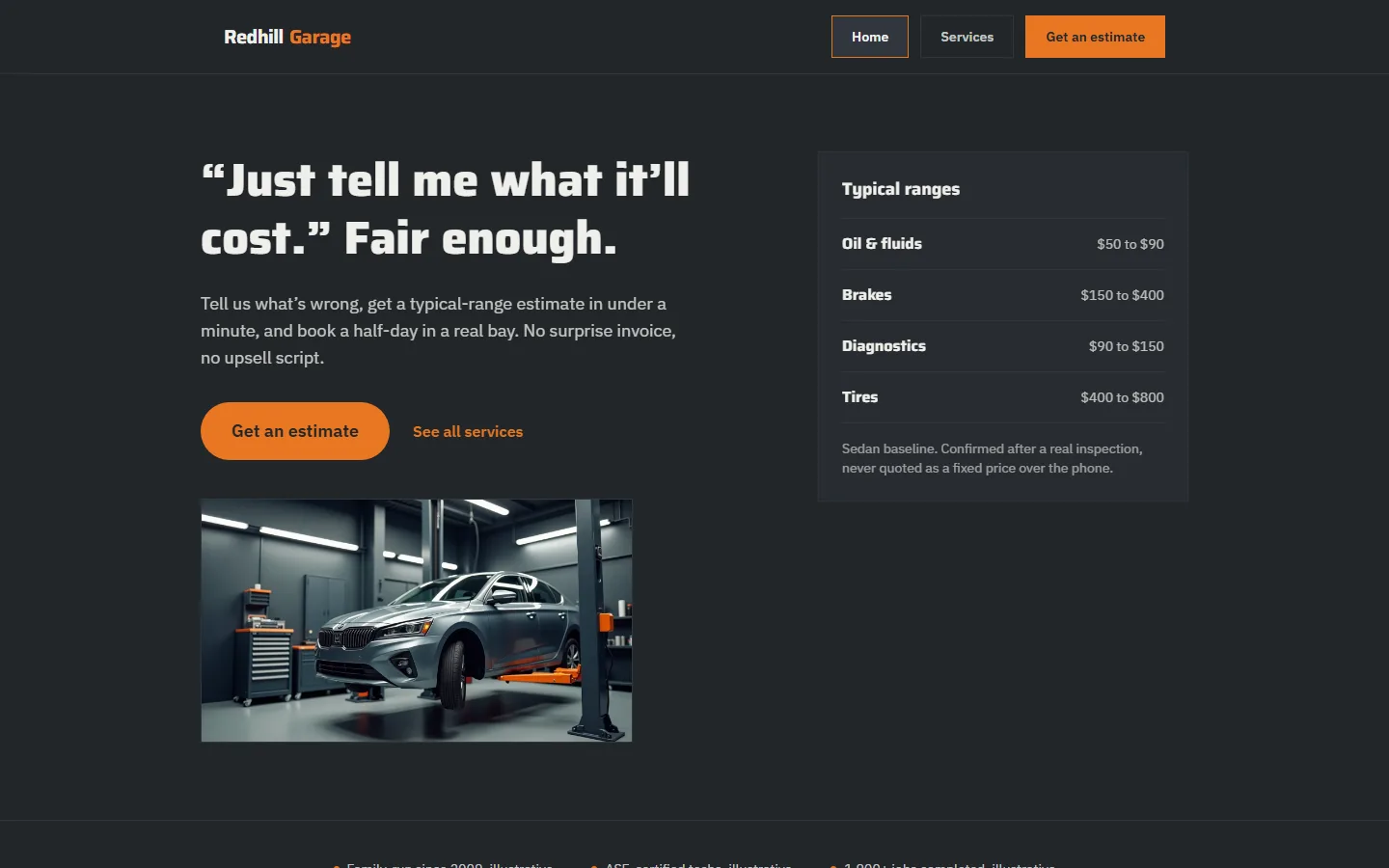
A workshop-honest garage site with an instant typical-range estimate (pick the service, pick the vehicle class, get a range back) and a service-bay half-day scheduler across three named bays, each capped at two jobs per half-day, booking a half-day with zero open capacity is rejected outright by the reducer. Behind it sits the owner's dashboard: eight weeks of numbers written as sentences rather than a chart of metrics, and self-serve edits to the headline, the line underneath and the picture, each previewed live before anything is published.
Decisions & why
A typical range instead of a single quoted price, always confirmed after inspection.
A brake job's real cost depends on what the mechanic finds. Publishing a range scaled by vehicle class, sedan, SUV, or truck, off a base per-service figure is honest about that uncertainty instead of promising a number the shop might not be able to honor once the car's on the lift.
Full half-days are a reducer no-op, not just a disabled button.
A bay at zero open capacity has to block the booking in code, not grey out a button. Baking the check into the reducer means the same guarantee holds no matter what path a click comes from.
Capacity summed across three named bays (two jobs each) instead of one shop-wide number.
North, Center, and South Bay each have their own schedule; showing the combined open capacity per half-day gives an honest picture of whether the shop can take the work, without asking a customer to pick a specific bay themselves.
Integer-cents math on every estimate, each bound rounded independently rather than derived from a rounded multiplier.
A pricing tool that drifts a few cents between the low and high end of its own range looks sloppy in a way a shop quoting real repair work can't afford. Rounding each bound on its own keeps the range internally consistent every time.
The dashboard reports in sentences, and its eight-week history includes a bad week.
An owner should be able to read the top of the page out loud to someone and have it make sense, which rules out a wall of sessions and bounce rates. The dip is deliberate too: a demo that only ever goes up teaches an owner to distrust the chart the first week theirs does not.
Every edit is validated with a sentence the owner can act on, and refused ones never reach the preview.
"You can't break the site from here" has to be code, not a promise. Angle brackets are rejected with an explanation rather than an error code, the length limit says how many characters to cut, and the picture can only be one the site already has, so a control panel never becomes a way to hotlink or inject anything.
The result it aims for
The build aims to give a driver a same-visit ballpark before they ever pick up the phone, and to book half-days against real bay capacity so the shop stops double-promising a lift that's already full.
This is the goal the build is designed to hit, not a measured client outcome.